
Para sport explained: Wheelchairs in wheelchair sports
25.06.2016Get to know the intricate details that go into wheelchairs in various Para sports.
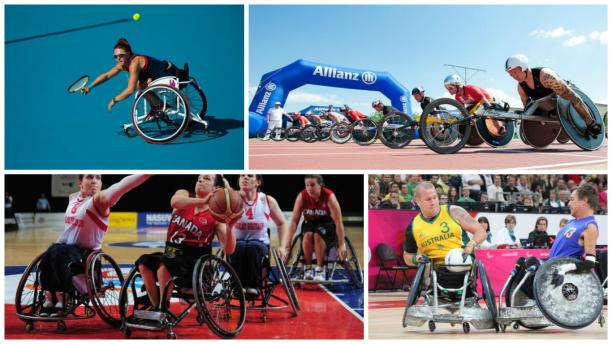 Wheelchairs used in basketball, rugby, athletics and tennis
© • IPC
Wheelchairs used in basketball, rugby, athletics and tennis
© • IPC

Just as football, tennis and basketball players wear different shoes on the playing field, Para athletes do likewise in wheelchair sports.
Never would you find a Para athlete use a racing chair – a three-wheeled contraption – to play a game of wheelchair basketball.
Perhaps a chair used in wheelchair tennis would be better, but it does not have the specific features needed to withstand crashes and contact with other chairs.
The wheelchairs used in Para sports are suited to fit athletes’ bodies and their impairments, depending on their sport, and allow them to maximise their performances in competitions.
The USA’s wheelchair racer Josh George is one who is familiar with the intricate details that go into chairs. He played wheelchair basketball but had to decide between that or athletics at his first Paralympic Games in Beijing 2008; he chose athletics.
Different push rims
The muscles George used to push a wheelchair in basketball are completely different than those for a racing chair.
Part of that is because of the difference sizes in the push rims.
“In a basketball chair, it’s all more explosive. So you need a much stronger back in basketball because you’re constantly stopping and changing directions, and that uses a lot of pulling muscles, whereas wheelchair racing is entirely pushing muscles,” George said.
In a basketball chair, athletes sit higher than on a racing chair, thus are using a bigger push rim that can range from 60-68cm in diameter, compared to 35-39cm.
This means an athletes’ stroke length is a lot shorter in wheelchair basketball and require quicker hands and explosive power to stop and change directions.
Meanwhile, everything that has gone into a racing wheelchair is designed for straight ahead speed, and athletes have to manage their energy efficiency depending on the distance they are racing, George said.
“It is not super nimble like a basketball or tennis chair,” George said. “You can’t stop [a racing chair] very easily. Once it’s rolling, you can’t hold it to a streaking halt like a basketball chair.
“If you race a basketball chair on the track, you would get crushed. Nowhere near as fast as a racing chair. And vice versa. If you took a racing chair on the basketball court you wouldn’t be able to do anything.”
Seating for stability
In wheelchair basketball, wheelchair tennis, wheelchair rugby and wheelchair racing, the seats vary depending on the athletes’ classification.
In wheelchair basketball, low-point athletes who have the least function in their lower body have more a “bucket seat” that allows for stability and typically have higher backrests compared to high-pointers.
High-pointers may also have a “sixth wheel” in the back that would allow them to lean as far back without flipping over and creating separation, whereas low pointers would typically have five wheels, one in the back opposed to two.
Stability for athletes of different classes in racing chairs is seen more in camber, which is the angle of the two main wheels.
The wider the wheelbase, the better the turn and lateral stability.
In basketball and tennis, chairs have 20 degrees of camber, which means the wheel is bent 20 degrees to the ground and allows the chair to turn really fast.
“In those sports [like wheelchair basketball and wheelchair tennis] you need chairs to turn fast,” George said.
Racing chairs on the other hand have 10-15 degrees of camber, mostly for lateral stability, especially around turns.
“When you’re coming around a turn in a three-wheel vehicle, three wheels are not steady and they’re not stable because you can’t bank,” George said. “When a bicycle on two wheels goes for a turn, you see a rider lean in and he is banking around on that turn. But you can’t do that with three wheels. So you rely on the wheelbase to hold you upright. Otherwise you’re going to flip sideways.”
Higher functioning athletes do not need much camber because they can use their bodies to lean over their chairs to keep it down. Although less camber rolls better, George said it does not make a difference on the track.
“In a marathon you want your chair to roll a little better to save energy,” George said. “But that doesn’t make you faster. You’re still going to be as fast – but it might save you a little energy toward the end of the race.”
Extra equipment
An added feature not on a racing chair are the gloves that the athletes use to push. In this way, they are not actually grabbing the push rim with their hands. The gloves allow them to put far greater power and have greater efficiency.
Wheelchair rugby players also use gloves to push and handle the ball, as athletes are tetraplegic. Their chairs also have protection on the wheels that hide the spokes to protect athletes who have little feeling in their hands.
Contact, non-contact sports
Chair-to-chair contact is inevitable in basketball and rugby. Thus, athletes’ chairs must be designed to withstand collisions. In wheelchair rugby, there are offensive and defensive chairs.
Offensive chairs are set up for speed and mobility and contain a front bumper and wings to prevent other wheelchairs from hooking it.
Defensive wheelchairs contain bumpers set up to hook and hold other players.
In wheelchair basketball, a rounded ring is in front to prevent chairs front getting stuck when they make contact.
However, wheelchair tennis does not have a specific feature to protect against contact, but rather longer, extended wheels in the front that would allow athlete to reach as far out to return shots.
And once an athlete finds a chair that they are comfortable with, they stick with it for all competitions in their sport.
“You will see chairs that are a little different based on a person’s individual disability,” George said.
“It’s a comfort thing. It’s relatively difficult to get comfortable in a chair and so once you are you want that chair to feel as much as part of your body as possible.”
Editor’s note: Para sport explained is a feature series on Paralympic.org that will publish once a month, helping the public understand different aspects of the Paralympic Movement.