12221
Go to International Paralympic Committee homepage Official website of the Paralympic Movement
Contrast:
High Contrast
Normal Contrast
Enlargement:
Larger Font Size
Default Font Size
Smaller Font Size
    • Home
    • Paralympic Games
    • Events & Competitions
    • The IPC
    • Results, Rankings & Records
    • Media centre
    • Sports
    • Classification
    • Videos
    • Athletes
    • Fan Zone
    • NPCs
    • Agitos Foundation
    • Partnerships
    • Newsletter
    • Facebook
    • Twitter
    • Youtube
    • Instagram

    Media Centre

    • News
    • Blogs
    • Newsletter
    • Magazine
    • Athlete of Month
    • Media Office
    • Ones to Watch
    • Campaigns
    • Top 10 Moments

    Para sport explained: How the Armless Archer shoots

    23.07.2016

    US Paralympic silver medallist Matt Stutzman explains how he shoots a bow and arrow without any arms.
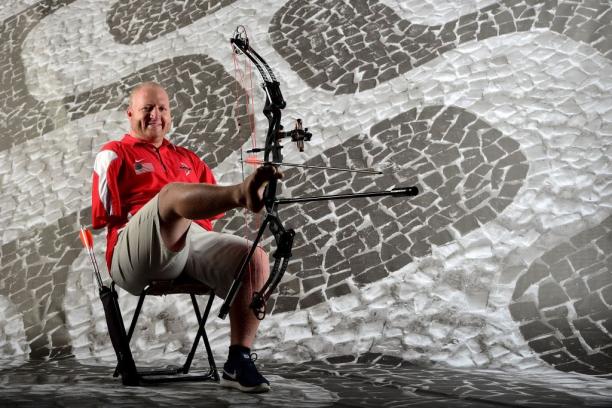
    Paralympic archer Matt Stutzman Paralympic archer Matt Stutzman © • Getty Images
    By IPC
    Listen to this page using ReadSpeaker
    Related News
    Para-sport explained: What happens during a doping control test?
    Para-sport explained: Classification in wheelchair dance sport
    Para sport explained: What does the IPC Athletes’ Council do?
    Para sport explained: Wheelchairs in wheelchair sports

    The USA’s Matt Stutzman, who was born without arms, taught himself how to shoot a bow and arrow by watching YouTube videos.

    Known as the “Armless Archer,” Stutzman would mimic the methods of an able-bodied archer in the video. For example, when the archer drew his bow with his right hand, Stutzman would draw the bow with his right foot.

    Eventually he developed his own mechanics, good enough to bring him to an intense final at the London 2012 Paralympics and left with the silver medal.

    As he targets gold in the men’s individual compound in Rio 2016, Stutzman explains his process:

    Step 1: Putting on the belt

    Stutzman first wraps a strap around his chest and over his shoulder. The strap has a release aid positioned over his right shoulder, and that is used to hook onto the bow string.

    All this was designed by Stutzman himself.

    He saw there was a strap that able-bodied archers would use; it goes around their wrists and has a trigger, similar to a gun. When the trigger is pulled, it activates the release of the arrow.

    “But it didn’t work for me because I don’t have any wrists,” Stutzman said. “Instead of using my lack of fingers to pull the trigger, I would use my jaw to pull the trigger.”

    Step 2: Loading the bow

    Preparing to shoot from a seated position, Stutzman picks up the arrow with his right foot and loads it into the bow.

    Once the arrow is in the bow, he grabs the bow with his right foot and crosses his legs “gentlemen’s style.”

    “What this does is it brings the bow up to my chest and then I bend down [toward the bow string]. I hook the release to my [bow’s] string which is on my right shoulder,” he said.

    When the string is anchored to the release aid, he sits up, and pushes his right leg away from his chest to draw the bow back.

    His left foot is on the ground for stability.

    Step 3: Aiming and shooting

    Once the string is connected to the release, Stutzman uses his right leg to push the bow away from his body.

    “Once I’m on target, I start my aiming process. I pull with my back and then I shoot the bow and hopefully score a 10,” Stutzman said.

    Changes since London 2012

    Up until London, Stutzman had been using his jaw to activate the release of the arrow. Heading into Rio 2016, he has been using his back more, with hopes that this slight change can bring him gold this time.

    “It helps me be consistent with my anchor,” Stutzman said. “I basically just pull with my back and it applies pressure to this release and allows it to shoot. It’s a lot more consistent. I can shoot it more relaxed. And I don’t get what we call target panic where your body thinking ‘shoot now, shoot now.’”

    Editor’s note: Para sport explained is a feature series on Paralympic.org that will publish once a month, helping the public understand different aspects of the Paralympic Movement.

    • Tweet
      • print
      • send
    LATEST NEWS
    Nottwil 2019: USA top table as Junior Worlds conclude 05.08.2019 Nottwil 2019: USA top table as Junior Worlds conclude
    Nadezhda Fedorova suspended for anti-doping violation 05.08.2019 Nadezhda Fedorova suspended for anti-doping violation
    Nottwil 2019: Breathless third day 04.08.2019 Nottwil 2019: Breathless third day
    Nottwil 2019: Noah Malone makes his way 03.08.2019 Nottwil 2019: Noah Malone makes his way
    Nottwil 2019: Mabote sets new world record inspired by teammate 02.08.2019 Nottwil 2019: Mabote sets new world record inspired by teammate
    More news...following the link
    Worldwide Paralympic Partners
    Go to Atos partner page
    Go to Bridgestone partner page
    Go to OttoBock partner page
    Go to Panasonic partner page
    Go to Samsung partner page
    Go to Toyota partner page
    Go to Visa partner page
    International Partners
    Go to Allianz partner page
    Go to BP partner page
    Go to Citi partner page
    • FAQ
    • Privacy
    • Imprint
    • Jobs
    Powered by Go to Atos. Worldwide IPC partner page
    The Paralympic Games
    Summer Games
    Winter Games
    Sochi 2014
    Rio 2016
    All the results & medallist since 1960
    Games video archive
    About the IPC
    Who we are
    Anti-Doping
    Medical
    Partners
    IPC Strategic Plan 2015-2018
    IPC Handbook
    Publications and Documents
    Media Centre
    News
    Features & Interviews
    The Paralympian
    Videos
    Athlete of the Month
    Media Office
    Sports
    Summer Sports
    Winter Sports
    Biographies
    NPCS
    Africa
    America
    Asia
    Europe
    Oceania
    Go to International Paralympic Committee homepage
    Official Website of the Paralympic Movement • IPC
    Homepage
    Paralympic Games
    The IPC
    Results, Ranking & Records
    Media Centre
    Videos
    Sports
    International Paralympic Committee (IPC)
    Adenauerallee 212-214, 53113 Bonn, Germany
    Telephone: +49-228-2097-200 • Fax: +49-228-2097-209 • E-mail: info@paralympic.org
    04:20:23